
[English Long Read] Restaking Track Review: Truths, Misconceptions, and the Unfinished Journey

Chainfeeds Guide:
After spending more than two years bringing all major AVSs onto EigenLayer and designing EigenCloud, this is my candid reflection on the entire journey: what misjudgments were made, what successes were achieved, and where we are headed next.
Source:
kydo
Opinion:
kydo: Launching EigenDA on top of the EigenLayer infrastructure was a huge positive surprise. It became the cornerstone of EigenCloud and gave Ethereum a much-needed super-scale DA track—allowing Rollups to advance rapidly without having to switch to a new L1 for performance reasons. The launch of MegaETH was because they believed Sreeram could help them break through the DA bottleneck. Mantle’s proposal to BitDAO to build an L2 was for the same reason. EigenDA also provides Ethereum with a layer of "shield." When there is a high-speed DA solution within the ecosystem, it becomes much harder for external L1s to leverage the Ethereum narrative to siphon value. One of EigenLayer’s early visions was to enable Ethereum to unlock preconfirmation. Later, preconfirmation received a lot of attention due to base rollup, but actual implementation remains difficult. To push the ecosystem forward, we jointly launched the Commit-Boost initiative, attempting to break the lock-in effect of preconfirmation clients and build a neutral platform where any team can innovate through validator commitment mechanisms. Today, the capital flow on Commit-Boost exceeds several billions of dollars, with over 35% of validators connected. As major preconf services go live in the coming months, this number will continue to rise. This is crucial to Ethereum’s anti-fragility and to the ongoing innovation in the preconf market. An underestimated impact of the restaking era is that a large amount of ETH flows to LRT providers, rather than pushing Lido all the way above 33%. This is significant for Ethereum’s social stability. If Lido were to stably occupy more than 33% for a long time without credible alternatives, governance conflicts and ecosystem splits would be severe. Restaking and LRT have not magically decentralized everything, but they have changed the trajectory of staking concentration. This is not meaningless. The biggest "victory" is conceptual. We have validated that the world indeed needs more verifiable systems. But the path is now very different from the original vision. Rather than starting from "broad cryptoeconomic security," insisting on complete decentralization from day one, and expecting everything to be routed from this layer, it’s better to directly provide developers with tools to apply verifiability and match each application with suitable verification primitives. You need to "meet" developers where they are, not require them to become protocol designers from the start. We began building internal modular services like EigenCompute and EigenAI to meet these real needs—things that other teams raise hundreds of millions of dollars and spend years to build, we can deliver in a few months. In the future, everything around EigenCloud will revolve around the EIGEN token. EIGEN will serve as: the core source of economic security; a collateral asset bearing multiple types of risk; and the main value capture for the entire platform’s fee flow and economic activity. Many early misunderstandings stemmed from the huge gap between "what users thought EIGEN would capture" and "what the actual mechanism can capture." The goal remains to enable more on-chain applications to safely use off-chain computation. But there won’t be only one tool—cryptoeconomic security, ZK, TEE, or hybrid technologies can all be used. The key is not to worship any particular technology, but to make "verifiability" a fundamental primitive that can be inserted into any application stack. The gap we want to bridge is from "I have an application" to "I have an application that can be verified by users, counterparties, and regulators." In reality, cryptoeconomic security + TEE is currently the strongest combination of programmability and practical security. When mechanisms like ZK mature, they will be integrated into EigenCloud. [Original text in English]
Disclaimer: The content of this article solely reflects the author's opinion and does not represent the platform in any capacity. This article is not intended to serve as a reference for making investment decisions.
You may also like
Bitcoin Bollinger Bands repeat ‘parabolic’ bull signal from late 2023

Bitcoin adds $732B in new capital this cycle as market structure transforms

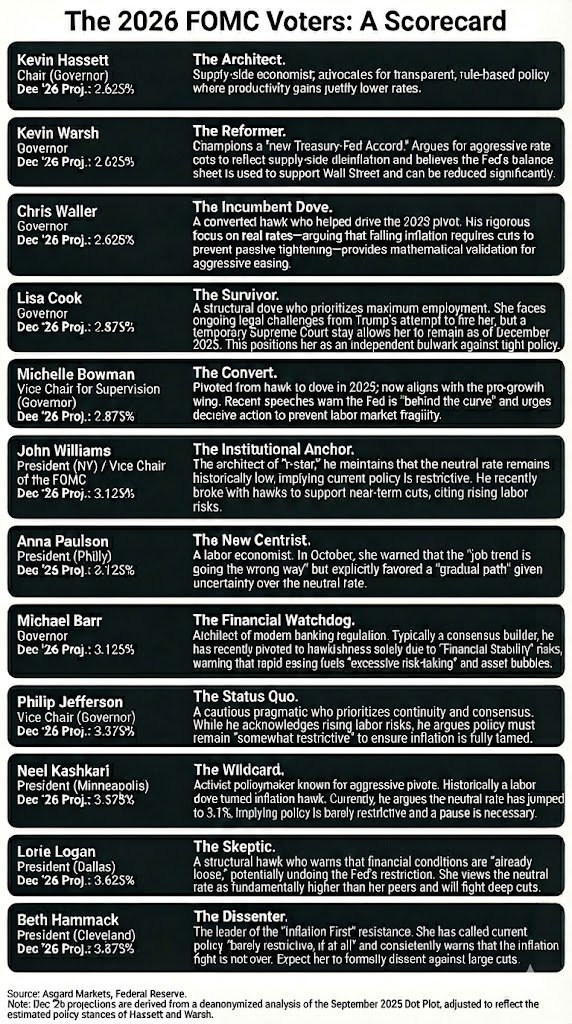
2026: The Year of Federal Reserve Regime Change
The Federal Reserve will shift away from the technocratic caution of the Powell era, moving toward a new mission that clearly prioritizes lowering borrowing costs to advance the president’s economic agenda.
Trending news
MoreCrypto prices
More






