
Ethereum Increases Data Throughput with Recent Scaling Update

Ethereum Expands Data Capacity to Support Network Growth
Ethereum, recognized as the second-largest blockchain globally, has recently boosted the volume of data it can process simultaneously.
Although this adjustment was anticipated and relatively minor, it plays a significant role in how Ethereum manages the rising demand from decentralized applications. It also offers insight into the network’s scaling strategy as user activity continues to climb.
Earlier this week, Ethereum co-founder Vitalik Buterin stated that recent upgrades have turned Ethereum into a “fundamentally new and more powerful kind of decentralized network,” one that can achieve security, decentralization, and scalability all at once.
Blobs: Enhancing Data Handling for Layer 2 Solutions
The latest improvements center on a feature called blobs. This mechanism ensures that transaction data from Layer 2 rollups—such as Base, Optimism, Arbitrum, and Mantle—is reliably published on Ethereum’s main chain.
Rollups allow transactions to be processed off the main Ethereum network while still benefiting from its security. This approach is also used for privacy-focused zero-knowledge rollups like zkSync Era, StarkNet, and Scroll.
Recent Network Upgrade: Increasing Blob Capacity
On Tuesday evening, Ethereum implemented its second scheduled Blob Parameter Only fork, which raised the network’s blob target from 10 to 14 and increased the blob limit from 15 to 21.
Blobs function by making rollup data accessible to all network participants for a set period, enabling transaction verification and state confirmation without the need for trusted third parties.
Alternative Data Availability Solutions
Platforms like Celestia, EigenDA, and Avail provide alternative methods for publishing rollup data. However, these solutions sometimes require balancing deeper Ethereum integration with higher throughput or reduced costs.
Since the initial Fusaka BPO fork, demand for blobs has steadily increased but remains well below capacity, indicating that Ethereum’s data layer still has ample room for growth.
According to data visualizations from GrowThePie, average blob usage continues to stay under the target threshold, even as total blob fees gradually rise. This suggests that while rollup activity is growing, it is not yet limited by available supply.
This trend supports Ethereum’s approach of gradually increasing data availability to prevent congestion before it becomes an issue.
Scaling Through Flexible Design
Experts interviewed by Decrypt believe that this fork demonstrates Ethereum’s ability to scale by dynamically adjusting its capacity.
“The BPO2 fork highlights that Ethereum’s scalability is now determined by parameters rather than fixed procedures. Blob space is far from being maxed out, and the network can boost throughput simply by modifying capacity,” explained Andrew Gross, a technical communications specialist at Blockscout, an open-source block explorer for Ethereum Virtual Machine-based chains, to Decrypt.
Benefits of the Upgrade
- Smoother rollup fee patterns
- Increased data headroom
- A system that adapts its scale in real time
Gross also noted that Ethereum’s modular structure now allows data availability to be managed as a flexible resource, rather than a limiting factor. “Ethereum has effectively become an adaptable base layer, able to grow with demand while maintaining decentralization and coordination stability,” he said.
Implications for Rollups and Fees
Christine Erispe, a developer advocate at Ethereum Philippines, told Decrypt that this seemingly small fork could have a notable impact when blobs become a bottleneck. “It provides extra capacity for rollups that frequently operate near the target,” she said.
She added, “This means more L2 batches can be processed in the same timeframe, or the same number of batches can be handled at a lower marginal blob price. Raising the target also reduces the likelihood of operating at maximum capacity, which is when rollups experience the highest blob fee spikes and the most unpredictable batch timing.”
Erispe further explained that the update shows Ethereum can address immediate rollup scaling needs by continuously tuning data availability, but this is just one part of a broader roadmap. “These parameter adjustments give Ethereum greater operational flexibility,” she said, suggesting that such structural changes could play a key role in Ethereum’s long-term evolution.
Disclaimer: The content of this article solely reflects the author's opinion and does not represent the platform in any capacity. This article is not intended to serve as a reference for making investment decisions.
You may also like
XRP ETF Withdrawn by Top Issuer: Key Reason
Banking Behemoth Morgan Stanley Files for Ethereum ETF
Top 3 Technology Stocks That May Deliver Your Highest Returns This Month
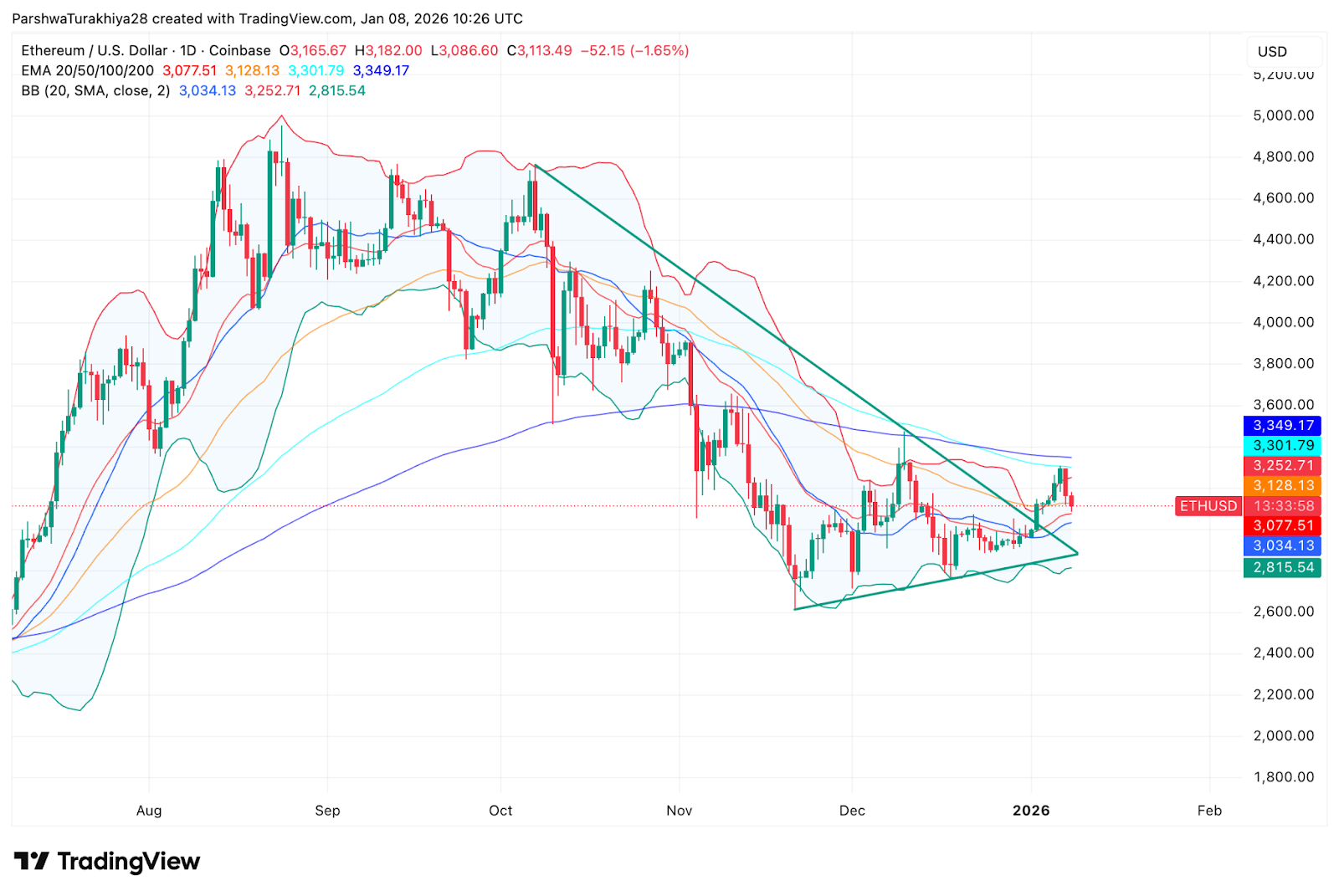
Ethereum Price Prediction: Descending Channel Caps ETH As Spot Outflows Persist
Trending news
MoreCrypto prices
More






