
Europe’s Stock Markets Log Their Strongest Week in Six Months

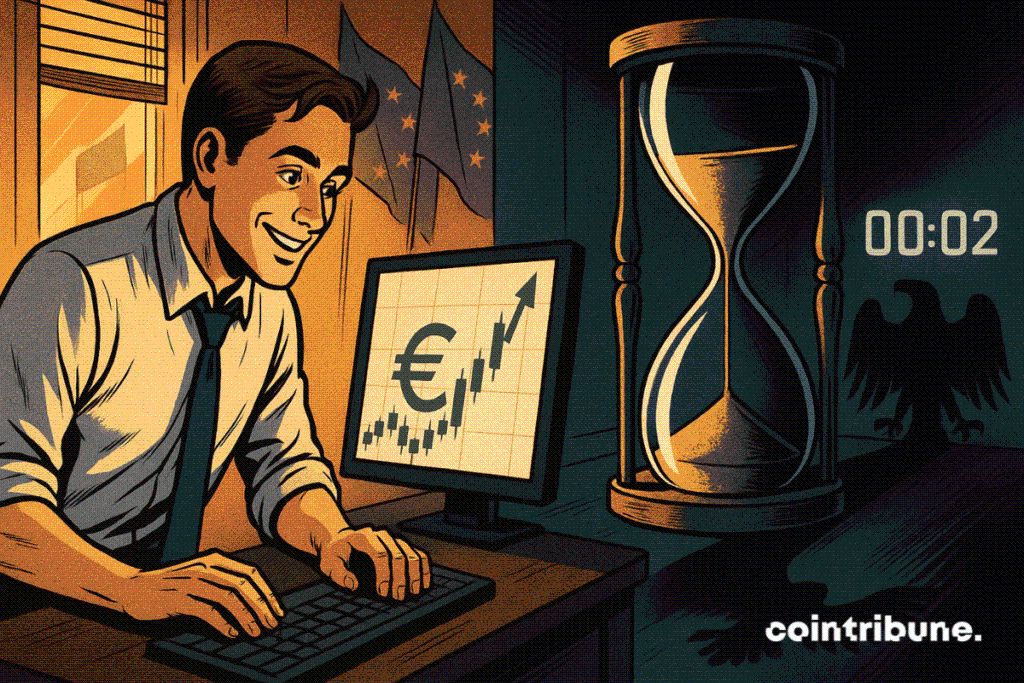
The European stock market has just closed an exceptional week. The STOXX 600 rises by 2.8% and continues to break historical records. Health, banks, and mining lead the way, driven by palpable optimism. But can this euphoria last in the face of the monetary turbulences looming across the Atlantic?
In brief
- The STOXX 600 rises by 2.8% over the week, setting three consecutive records and marking its best weekly performance in six months.
- The sectors of health, banks, and mining lead the way, with spectacular leaps by AstraZeneca, Novo Nordisk, and Raiffeisen.
- Investors are betting heavily on another Fed rate cut this month, despite the delay in the US employment report.
- The performance gap between the STOXX 600 (+12.4%) and the S&P 500 (+14.7%) gradually narrows over the year.
A Golden Week for the European Stock Market
European markets have recorded their best week in six months. The STOXX 600 rose by 0.5% on Friday, achieving a third record in a row, for a weekly gain of 2.8%.
A notable performance for the European stock market, while on the other side of the Atlantic, the threat of an American shutdown unsettles the markets , weakens the dollar, and pushes gold higher.
The health sector established itself as the main driver of this momentum. On Friday, it rose by 1.3%, buoyed by giants AstraZeneca (+1.6%) and Novo Nordisk (+2.1%). This surge followed a price agreement reached by Pfizer in the United States, which helped ease concerns related to tariffs.
For UBS, “While the Pfizer deal is not an outright ‘all clear’ signal for the sector, with key details lacking on the tariffs, a boost in near-term sentiment and robust long-term drivers should support a positive outlook”, even if the details of the agreement remain incomplete.
Banks also largely contributed to this improvement. The sector rose by 1%, with a remarkable performance from Raiffeisen, up 7.4%. This surge is explained by discussions within the European Union on a possible lifting of sanctions targeting the Russian billionaire Oleg Deripaska’s assets, in order to compensate the Austrian bank. ABN Amro also stood out, gaining 2.7% after Goldman Sachs upgraded its recommendation from “sell” to “buy”.
Finally, mining companies completed this positive picture. The basic resources index increased by 1.7%, supported by the rise in metal prices. Thanks to this collective performance, the STOXX 600 now shows a gain of 12.4% since the beginning of the year, narrowing the gap with the American S&P 500, up 14.7%. The European stock market thus regains a momentum that brings it closer to Wall Street.
The Fed at the Center of All Attention
The budget paralysis in Washington postponed the publication of the US employment report, initially expected on Friday. Yet this document is a crucial reference for the Federal Reserve, which uses it to calibrate its monetary policy. However, this setback did not dampen the optimism of European investors.
According to the CME FedWatch tool, markets almost unanimously expect another Fed rate cut by the end of the month.
Fiona Cincotta, analyst at City Index, sums up the prevailing mindset well: “It does very much feel that the market is looking past the ongoing U.S. government shutdown and focusing on Fed rate cut expectations“.
This confidence is notably supported by a disappointing report on private employment published earlier in the week.
But behind this enthusiasm lies a complex equation. Jerome Powell has reminded that no decision on interest rates is without risk. The Fed finds itself in a strategic deadlock. Some members, like Stephen Miran, advocate for more clear cuts to support employment, while others fear persistent inflation, at 2.9%, which is above the 2% target.
In Europe, the picture remains mixed. The Eurozone services sector grew at its fastest pace in eight months, driven by Germany. France, on the other hand, experienced a stronger than expected contraction, and the United Kingdom saw its activity slow to a five-month low.
Will this European momentum, fueled by hopes for US monetary easing , be sustainable? It will all depend on the Fed’s decisions and its ability to balance employment and inflation. For now, the markets prefer optimism. But economic reality could quickly call them to order.
Disclaimer: The content of this article solely reflects the author's opinion and does not represent the platform in any capacity. This article is not intended to serve as a reference for making investment decisions.
You may also like
The Growing Buzz Around Momentum (MMT) Token: Could This Be the Next Major Opportunity in Crypto Investments?
- Momentum (MMT) token surged 4,000% post-2025 TGE, driven by exchange listings and speculative demand, despite a 70% correction. - Institutional adoption accelerated by $10M HashKey funding and regulatory frameworks like MiCAR, while Momentum X targets RWA tokenization. - Retail investors face volatility risks from leveraged trading and token unlocks, contrasting institutions' focus on compliance and stable exposure. - Technical indicators show mixed outlook, with RSI suggesting potential bullishness but

Tech Learning as a Driver of Progress in 2025
- Global demand for AI, cybersecurity, and data science education drives enrollment surges, with U.S. AI bachelor's programs rising 114.4% in 2025. - Institutions innovate through interdisciplinary STEM programs and digital ecosystems, addressing workforce gaps with AI ethics and immersive tech integration. - Education-tech stocks gain traction as hybrid learning models and AI-driven platforms align with $4.9 trillion digital economy growth and rising cybersecurity job demand. - Federal funding challenges

TWT's Tokenomics Revamp for 2025: Supply Structure Adjustment and Lasting Value Impact
Aster DEX: Connecting Traditional Finance and DeFi by Streamlining Onboarding and Encouraging Institutional Participation
- Aster DEX bridges TradFi and DeFi via a hybrid AMM-CEX model, multi-chain interoperability, and institutional-grade features. - By Q3 2025, it achieved $137B in perpetual trading volume and $1.399B TVL, driven by yield-bearing collateral and confidential trading tools. - Institutional adoption surged through compliance with MiCAR/CLARITY Act, decentralized dark pools, and partnerships with APX Finance and CZ. - Upcoming Aster Chain (Q1 2026) and fiat on-ramps aim to enhance privacy and accessibility, pos

Trending news
MoreCrypto prices
More





