PIPE deals can create significant selling pressure for crypto treasury companies: when private investors buy discounted new shares and later sell after lock-up expiry, share prices often gravitate toward the PIPE price, risking declines of up to 50% for affected firms.
-
PIPE issuance often leads to stock overhang and dilution.
-
Lock-up expiries can trigger rapid selling and steep intraday drawdowns.
-
CryptoQuant found examples where post-PIPE selling drove shares toward issuance levels, sometimes falling 50–97%.
Meta description: PIPE deals risk for crypto treasury companies — learn how PIPE investors create selling pressure and what indicators to watch. Read COINOTAG analysis now.
CryptoQuant said crypto treasury companies that cut deals to sell new shares to private investors face downside risks due to incoming selling pressure.
What are PIPE deals and why do they matter for crypto treasury companies?
PIPE deals (private investment in public equity) let firms sell new shares at a discount to private buyers to raise cash quickly. For crypto treasury companies, PIPEs can provide immediate liquidity but often increase share supply, creating resale overhang that pressures stock prices when investors can sell.
How do PIPE investor lock-ups create selling pressure and drive share declines?
PIPE investors frequently agree to lock-up periods before resale. When those lock-ups end, concentrated selling can follow. CryptoQuant’s analysis shows several Bitcoin-treasury firms saw their shares decline toward PIPE issuance prices once selling began, with some stocks losing more than half their value in short windows.
PIPEs dilute existing shareholders by increasing outstanding shares. The resale of discounted new shares often forces the market to reprice the stock closer to the PIPE level. In several observed cases, actual selling — or the anticipation of it — created sustained downward pressure on the equity.
How did the Kindly MD example illustrate PIPE risk?
CryptoQuant highlighted Kindly MD (NAKA) as a cautionary example: shares surged from roughly $1.80 in late April to an intraday high near $35 after a PIPE announcement, then collapsed by 97% to around $1.16 — essentially touching the $1.12 PIPE price once resale activity began.
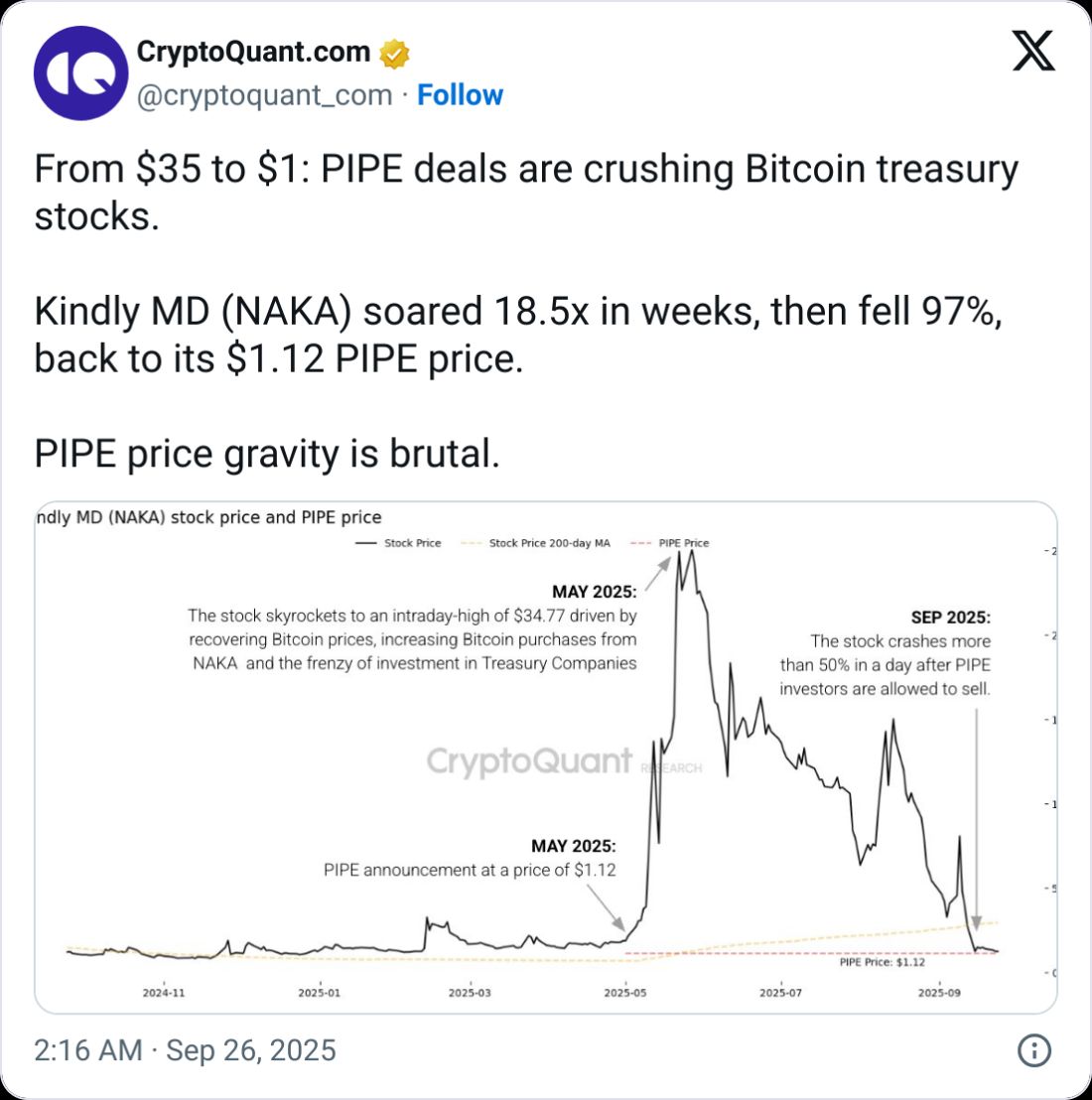
Chart showing Kindly MD’s share price overlaid with key events related to its PIPE deal. Source: CryptoQuant
Which other crypto treasury stocks show PIPE vulnerability?
Several public crypto treasury firms have similar setups. Strive Inc. (ASST) closed at $2.75 after peaking near $13 in 2025; its PIPE was priced at $1.35, implying potential downside if PIPE holders sell. Cantor Equity Partners’ (CEP) PIPE was $10 and the stock has fallen markedly from prior highs, indicating pressure toward issuance levels.
Analysts cite the rising market value of crypto holdings relative to company market caps as another factor: when on-chain asset values approach firm valuations, selling incentives can increase, amplifying PIPE overhang effects unless a robust Bitcoin rally intervenes.
How can investors assess PIPE-related downside risk?
- Check PIPE terms: note issuance price, lock-up length, and tranche schedules.
- Monitor outstanding shares: quantify dilution percentage and float changes after issuance.
- Watch lock-up expiries: identify upcoming unlock dates and potential concentrated sellers.
- Compare market price vs PIPE price: stocks trading above PIPE price are more vulnerable.
- Evaluate treasury crypto exposure: rising crypto valuations can mitigate downside risk.
Frequently Asked Questions
How much can PIPE selling push a share price down?
PIPE selling can push share prices down substantially; CryptoQuant observed potential declines up to 50% for some firms, and extreme cases (e.g., Kindly MD) saw near-total reversions to PIPE levels. Impact depends on float size and market liquidity.
Can a Bitcoin rally prevent PIPE-driven declines?
A sustained Bitcoin rally can offset selling pressure by increasing firm asset values and investor demand. CryptoQuant notes such a rally is the most likely catalyst to prevent further declines in affected treasury stocks.
Key Takeaways
- PIPEs raise cash quickly: but increase share supply and dilute existing holders.
- Lock-up expiries matter: concentrated selling at unlocks can drive steep drawdowns.
- Monitor issuance versus market price: stocks trading above PIPE price are at higher risk; track upcoming unlock dates.
Conclusion
PIPE deals remain a fast way for crypto treasury companies to access capital but introduce measurable downside risk through dilution and resale overhang. Investors should evaluate PIPE terms, outstanding share changes and lock-up schedules while watching on-chain asset trends. COINOTAG will monitor developments and update this analysis as new data emerges.