
Fed’s Delicate Act: Weighing Declining Claims Against Slower Employment Expansion
- U.S. jobless claims dropped to 218,000 in late September, the lowest in two months, signaling mixed labor market resilience. - Revised data showed weaker 12-month job growth (down 911,000) and 22,000 August jobs added, prompting Fed's 25-basis-point rate cut. - Fraudulent claims in Texas skewed data, while unemployment rose for young graduates (4.59%) and white-collar workers amid AI disruption. - Market reactions included a weaker dollar and Bernstein raising IREN's price target to $75, as Fed faces bal
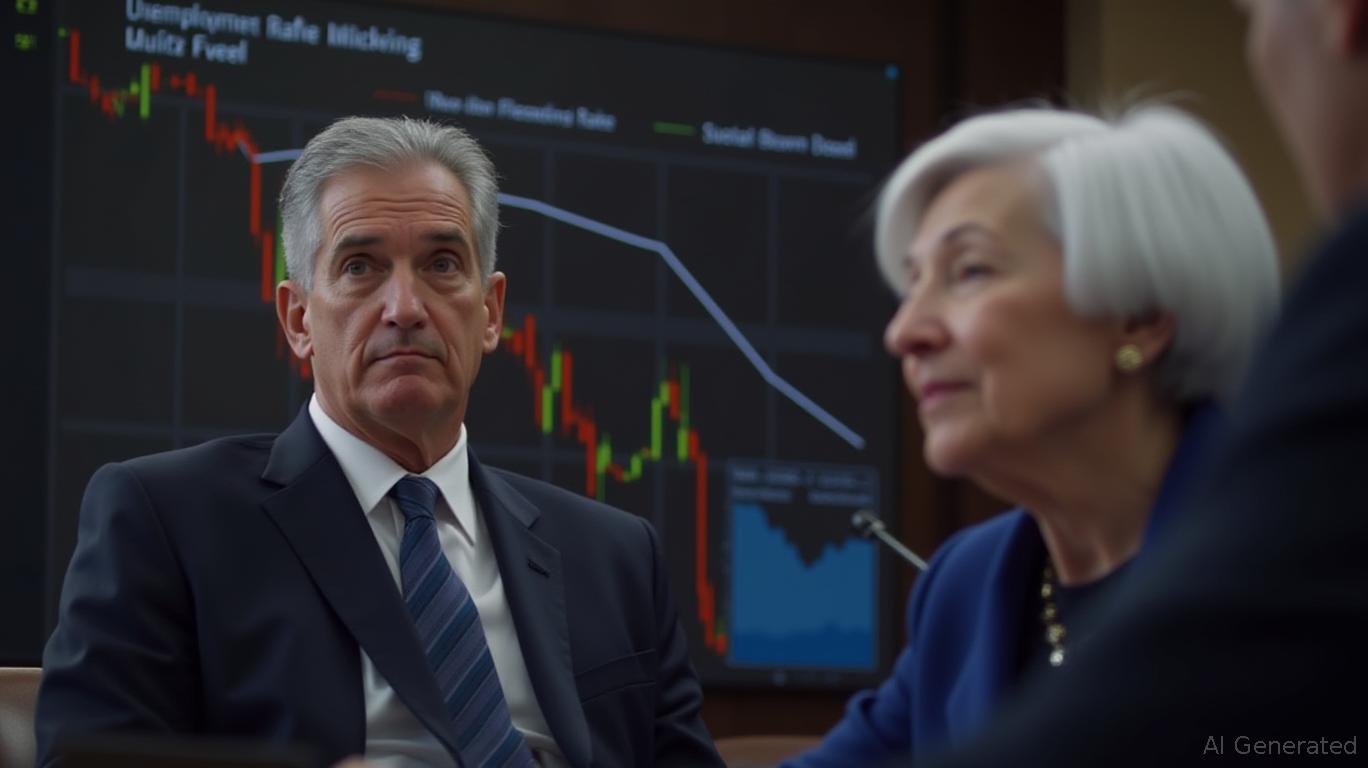
In late September, U.S. unemployment claims dropped to their lowest point in two months, offering a mixed outlook for the job market as officials contend with signs of slowing employment. The Labor Department reported that initial applications for jobless benefits fell by 14,000 to 218,000 for the week ending September 20 title1 [ 1 ]. This was a notable decrease from the prior week’s revised figure of 232,000 and was below the FactSet estimate of 235,000. The four-week moving average, which helps smooth out fluctuations, also declined by 2,750 to 237,500 title1 [ 1 ].
This reduction in claims stands in contrast to broader employment data that has fueled worries about the labor market’s strength. The Bureau of Labor Statistics (BLS) recently lowered its estimate of job gains for the 12 months ending March 2025 by 911,000, indicating that employment growth was weaker than previously thought title1 [ 1 ]. In August, the BLS reported only 22,000 new jobs, well below forecasts, and noted that job openings dropped to 7.2 million in July—marking the first time since April 2021 that the number of unemployed Americans exceeded available positions title1 [ 1 ]. These developments influenced the Federal Reserve’s decision to lower its key interest rate by 25 basis points at the end of September, shifting its attention from inflation to supporting job stability title1 [ 1 ].
Issues such as fraudulent claims and irregularities in the data have further muddied the labor market picture. For the week ending September 13, initial claims dropped by 33,000 to 231,000, largely due to a spike in Texas where incorrect and fraudulent filings had previously inflated the numbers title2 [ 2 ]. Continuing claims, which count those still receiving unemployment benefits, fell to 1.92 million in early September, the lowest since late May title2 [ 2 ]. However, the BLS revised its August job growth down to 73,000 from an earlier estimate of 100,000 title1 [ 1 ].
The uneven state of the labor market has affected different groups in varied ways. Recent college graduates and younger workers have been hit especially hard, with unemployment among 23- to 27-year-old graduates averaging 4.59% in 2025, up from 3.25% in 2019. White-collar sectors, such as technology and the arts, have also experienced higher unemployment, reflecting growing concerns about job losses due to technological change and AI automation.
Financial markets have responded inconsistently to these developments. The U.S. dollar weakened in early September as investors anticipated a greater chance of further rate cuts by the Fed title7 [ 4 ]. Bernstein analysts increased their price target for IREN, a
Data from the Labor Department highlights the Federal Reserve’s challenge: finding a balance between keeping inflation in check and maintaining job stability. While the drop in jobless claims points to some resilience in the labor market, downward revisions to job growth and persistent inflation above the 2% target complicate the Fed’s policy choices. The central bank’s future actions will likely depend on whether the job market can maintain its current path or if further weakening appears.
Disclaimer: The content of this article solely reflects the author's opinion and does not represent the platform in any capacity. This article is not intended to serve as a reference for making investment decisions.
You may also like
Ether vs. Bitcoin teases 170% gains as ETH price breaks 5-month downtrend

Navigating Fluctuating Markets: Insights Gained from Recent Declines in Prices
- 2023-2024 markets saw Fed rate hikes (5.25%-5.50%) then cuts, driving S&P 500/Nasdaq surges led by Magnificent Seven tech stocks. - AI euphoria and Trump-era trade uncertainty created valuation risks, with NVIDIA up 1,150% since 2023 and small-cap/crypto surges. - Historical parallels to 2000 dot-com and 2008 crises highlight dangers of overconcentration in high-growth tech and fragile diversification. - Resilient portfolios require diversification beyond tech, active management (hedge funds/private equi

Anthropological Insights into Consumer Actions in Digital Advertising: Investing Strategically in Culturally Sensitive Advertising Technology
- Digital advertising is transforming via ethnographic research and AI, driven by Farmingdale’s anthropology curriculum and IAB’s AI initiatives. - Ethnographic methods, like TESS, decode cultural behaviors in digital spaces, enabling hyper-segmented campaigns beyond demographics. - IAB’s AI-driven ad tech requires culturally rich data to train models, aligning with privacy standards and regional regulations like GDPR. - Investors should prioritize platforms integrating ethnographic insights with AI, enhan

Cryptocurrency Price Fluctuations and Technical Strategies in the Market After 2025: Assessing Immediate Momentum and Approaches to Risk Control for Tokens Such As
- Pudgy Penguins (PENGU) exhibits extreme 2025 volatility, surging 25% then retreating 30%, with 14.46% volatility metrics highlighting crypto market instability. - Technical indicators show conflicting signals: 4-hour bullish momentum vs. daily bearish patterns, while institutional inflows ($430k) contrast with bearish sentiment (Fear & Greed Index at 28). - Risk management is critical as PENGU faces key thresholds ($0.010 support, $0.014 resistance), with potential for $0.069 rebound or $0.008645 decline
Trending news
MoreCrypto prices
More





